
The James Webb Space Telescope’s Most Stunning Discoveries of 2025
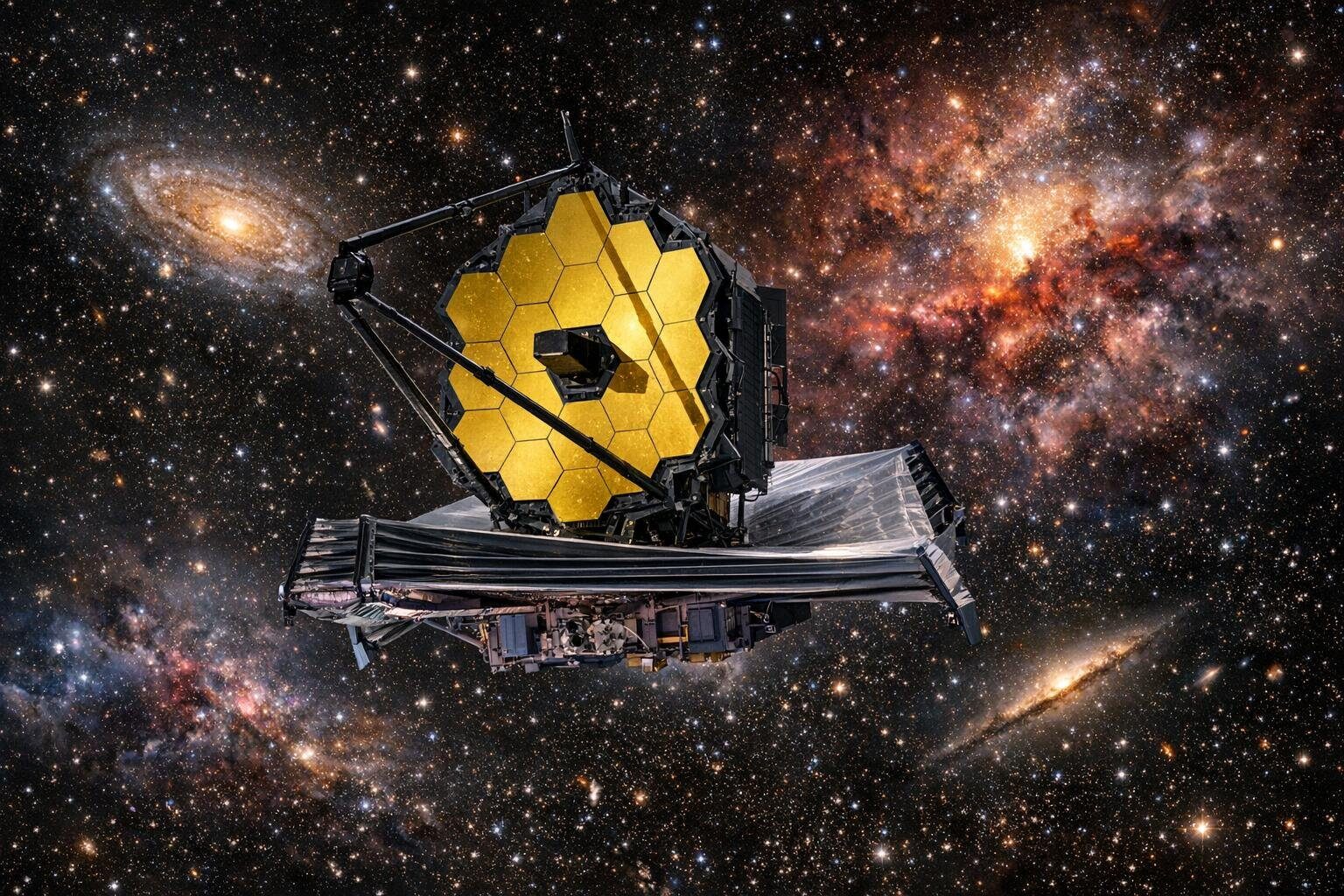
Since its launch in December 2021, the James Webb Space Telescope (JWST) has consistently rewritten our understanding of the cosmos. But 2025 may well be remembered as the year Webb truly changed everything. From detecting the chemical fingerprints of alien atmospheres to capturing images of galaxies that shouldn’t exist, here are the most breathtaking discoveries JWST delivered this year.
A Potentially Habitable World Around a Nearby Star
In March 2025, NASA announced that Webb had detected a compelling combination of water vapor, carbon dioxide, and, most intriguingly, dimethyl sulfide in the atmosphere of exoplanet K2-18 b. On Earth, dimethyl sulfide is produced almost exclusively by living organisms. While scientists caution that this is not definitive proof of life, the detection sent shockwaves through the scientific community. Follow-up observations are already underway, and K2-18 b has become the most studied exoplanet in history.
The Oldest Galaxy Ever Observed
Webb’s NIRCam instrument identified a galaxy dating back just 260 million years after the Big Bang, making it the most distant and oldest galaxy ever confirmed. Designated JADES-GS-z16-0, the galaxy is surprisingly bright and structured for its age, challenging existing models of early cosmic evolution. Its discovery suggests that star formation began far earlier and more vigorously than previously thought, forcing astrophysicists to rethink the timeline of the universe’s first light.
Organic Molecules in a Protoplanetary Disk
Using its Mid-Infrared Instrument (MIRI), Webb detected complex organic molecules, including polycyclic aromatic hydrocarbons and simple amino acid precursors, within a planet-forming disk around a young star roughly 1,300 light-years away. This finding strengthens the hypothesis that the building blocks of life are delivered to planets during their formation, rather than arising solely through later chemical processes on their surfaces.
Direct Imaging of a Super-Earth
In a remarkable engineering feat, the Webb telescope captured the first direct infrared image of a rocky super-Earth orbiting a sun-like star. The planet, designated HD 86226 c, had previously only been detected through transit observations. Webb’s coronagraph blocked the overwhelming glare of the host star, revealing the faint thermal glow of the planet itself. This breakthrough opens the door to directly studying the surfaces and atmospheres of rocky worlds for the first time.
Supermassive Black Hole Seeds in the Early Universe
One of the most puzzling questions in astrophysics, which is how supermassive black holes grew so large so quickly, may finally have an answer. Webb observations in 2025 revealed a new class of ultra-compact, high-redshift objects that appear to be “heavy seeds,” massive black holes that formed directly from collapsing primordial gas clouds rather than growing slowly from smaller stellar remnants. These findings provide strong evidence for the direct-collapse model and could reshape our understanding of galaxy formation.
What Comes Next
With its instruments performing flawlessly and a fuel supply that could last well into the 2040s, the James Webb Space Telescope shows no signs of slowing down. Upcoming observation cycles will focus on mapping the atmospheres of dozens more exoplanets, studying the first generation of stars, and probing the mysterious nature of dark energy. If 2025 is any indication, the best discoveries are still ahead of us.
The universe, it turns out, is even more extraordinary than we imagined, and Webb is proving it one infrared photon at a time.