
What Happens If You Fall Into a Black Hole?
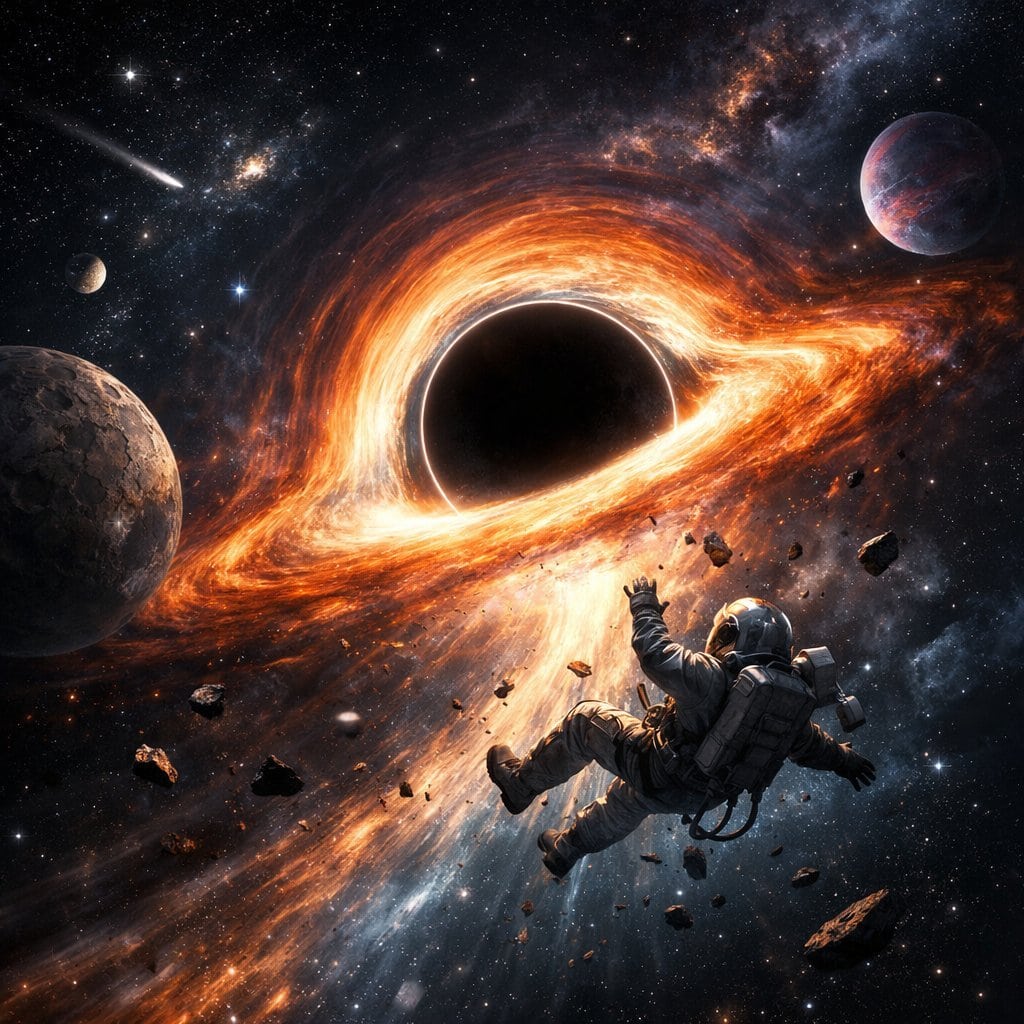
Have you ever wondered what would happen if you accidentally fell into a black hole? It’s one of the most fascinating and terrifying questions in all of space science! Black holes are some of the most mysterious objects in the universe, and the experience of falling into one would be unlike anything else imaginable.
Black holes are regions in space where gravity is so incredibly strong that nothing – not even light – can escape once it crosses a certain boundary called the “event horizon.” This boundary is essentially the point of no return. But what exactly would happen to you if you crossed it?
The Journey Begins: Approaching the Black Hole
As you approach a black hole, the first thing you’d notice is that time itself starts behaving strangely. From your perspective, everything would seem normal. However, if someone was watching you from a safe distance away, they would see you moving slower and slower as you got closer to the event horizon. In fact, to them, you would appear to freeze in time right at the edge of the black hole, never quite crossing over!
This bizarre effect is called “time dilation,” and it’s a consequence of Einstein’s theory of relativity. Time moves differently in areas of extremely strong gravity, and black holes have the strongest gravity in the universe.
Spaghettification: A Stretchy Situation
Here’s where things get really wild. As you fall closer to the black hole, you would experience something scientists actually call “spaghettification” – and yes, that’s the real scientific term! The gravity at your feet (assuming you’re falling feet-first) would be pulling you much harder than the gravity at your head, because your feet are closer to the center of the black hole.
This difference in gravitational pull would stretch you out like a piece of spaghetti, pulling you longer and thinner. For smaller black holes, this would happen well before you reached the event horizon. For supermassive black holes – the kind found at the centers of galaxies – you might actually make it across the event horizon before being stretched!
Crossing the Event Horizon
If you somehow survived long enough to cross the event horizon (which, realistically, you wouldn’t), there would be no turning back. Even if you had a rocket capable of traveling at the speed of light, you couldn’t escape. The fabric of space itself is falling into the black hole faster than light can travel outward.
Interestingly, you wouldn’t actually feel anything special at the moment you crossed the event horizon. There’s no wall or barrier – just an invisible boundary in space. But from that point on, every direction you could possibly travel would lead you toward the center of the black hole.
The Final Destination: The Singularity
At the very center of a black hole lies what scientists call a “singularity” – a point where all the black hole’s mass is concentrated and where the laws of physics as we know them break down completely. What actually happens at the singularity is one of the biggest unsolved mysteries in physics!
Our current understanding of physics simply doesn’t work when gravity becomes this extreme. Scientists believe that to truly understand what happens at the singularity, we would need a theory that combines quantum mechanics and gravity – something physicists are still working on today.
Would Anyone Know What Happened?
Here’s an interesting thought: because of time dilation, anyone watching you fall into a black hole would never actually see you cross the event horizon. They would see you slow down, get dimmer and redder (due to another effect called “gravitational redshift”), and eventually fade from view. To them, you would appear frozen in time at the edge of the black hole forever!
Meanwhile, from your perspective, you would cross the event horizon and reach the center in a finite amount of time – though you wouldn’t survive the journey due to spaghettification and other extreme effects.
Types of Black Holes
It’s worth mentioning that not all black holes are the same! There are several types:
- Stellar black holes: Formed when massive stars collapse. These are typically 3 to 20 times the mass of our Sun.
- Supermassive black holes: Found at the centers of galaxies, these can be millions or even billions of times the mass of the Sun. There’s one at the center of our own Milky Way galaxy!
- Intermediate black holes: Between stellar and supermassive black holes, though these are harder to find.
- Primordial black holes: Theoretical black holes that might have formed in the early universe.
The size of the black hole would actually affect your experience. With a supermassive black hole, you might survive longer because the tidal forces (the difference in gravity between your head and feet) would be weaker until you got very close to the center.
The Bottom Line
While falling into a black hole would certainly be an incredible (if brief) experience, it’s not something anyone would want to try! The good news is that the nearest known black hole to Earth is about 1,000 light years away, so we’re perfectly safe from accidentally falling into one.
Black holes remain one of the most fascinating subjects in astronomy and physics. They challenge our understanding of space, time, and the very laws of nature. While we may never know firsthand what it’s like to fall into one, scientists continue to study these cosmic monsters to unlock the secrets of the universe!
What do you think is the most fascinating aspect of black holes? Their ability to warp time? The mysterious singularity at their center? Or perhaps the fact that they’re invisible yet incredibly powerful? Let us know in the comments!
